


Concrete nature conservation measures at three locations in Sweden
Forest and Pollinators is a project carried out by Partner in Pet Food Nordics AB together with Initiativ 1415. The project includes tree planting in Tanum, forest conservation in Tväråträsk and measures for wild pollinators in Bålsta.
On this page, we describe the measures that have been implemented and the observations made during follow-ups.
Go directly to:
Overview: Our project sites
The project sites are in Sweden, making it possible for the project partners and employees to visit the sites and follow their development. Natural environments change over time. This is why we describe both what has been established and what still needs to be supplemented.

Tree planting and forest conservation
The project includes the planting of approximately 6,000 trees in Tanum and the conservation of forest in Tväråträsk. Trees absorb carbon dioxide as they grow, but the actual amount varies depending on factors such as tree species, growth rate, survival rate, soil conditions and time period.
According to the project’s calculation basis, the measures are estimated to correspond to approximately 600 tonnes of CO₂e in carbon sequestration over the period and under the assumptions stated in the documentation. This calculation is a forecast, not an already achieved result.
The tree planting takes place in Tanum in Västra Götaland, and the forest preserved from harvesting is located in Tväråträsk, Sorsele in Västerbotten. Planting will be carried out in 2024, with some pre-planting taking place in autumn 2023. The landowners involved in the forest conservation part of the project are certified according to FSC and PEFC standards for sustainable forestry
Why are we doing this?
Forests are an important sink for greenhouse gases. Trees absorb carbon dioxide as they grow, and forests play an important role in the carbon cycle by storing carbon in biomass and soil.
The project includes measures to conserve existing forest and establish new forest in selected areas in Sweden. The purpose is to support the long-term storage of carbon in the forests covered by the project, based on the project’s assumptions and follow-up, while also creating conditions for more varied forest environments.
Project objectives
The project is carried out in collaboration with the Swedish company Initiativ 1415. Within the project, existing forests are conserved and new forests are established in selected areas. The objective is to support the long-term development of the biogenic carbon sink in the forests covered by the project.
The project uses a planting model in which approximately 2,000 seedlings are planted per hectare. According to the project’s calculation model, this corresponds to an estimated future carbon sequestration of approximately 200 tons of carbon dioxide per hectare, or around 100 kg of carbon dioxide per seedling over its lifetime. The calculations are based on the assumptions and methods used within the project and are forecasts, not guaranteed outcomes.
To increase variation in the new forests, at least 15 percent of the trees are planted. These include willow and rowan, species which, according to the project guidelines, provide pollen and nectar resources for different insects. For the forests that are conserved, carbon sequestration is calculated based on the respective forest management plan. Management and conservation measures are planned so that the calculated reference level for carbon sequestration is not expected to fall below the stated level during the project period, which covers at least 20 years. Examples of measures that may be carried out within the project include management of key habitats or conservation and improvement of habitats for identified red-listed species within the project areas.

Measures for wild pollinators in Bålsta
In Bålsta, the project has implemented measures intended to provide food sources, nesting opportunities and more varied habitats for pollinating insects and other species. The measures have been selected with reference to publicly available recommendations from the Swedish Environmental Protection Agency, the Swedish Board of Agriculture and the County Administrative Board. The project site will be monitored over a ten-year period.
The biodiversity project is in Bålsta, Uppsala County. On an area of one hectare, slightly larger than a football pitch, the project is establishing habitats for pollinators on Swedish agricultural land. Several specific measures have been implemented to create nesting opportunities and food environments for bees and other insects.
To support better conditions for biodiversity, the project focuses on measures such as:
- Planting selected species of trees and shrubs, such as oak, willow, rowan, Swedish whitebeam, hawthorn, guelder rose and blackberry.
- Sowing wildflower meadows that provide pollen and nectar. A wide variety of flowering plants is important to support different types of pollinators, preferably with species that flower at different times during the season. The project uses Malmgård Viltfrö seed mixtures with species that flower from June to September.
- Placing two straw bales where bees and other insects can build nests.
- Creating two sand beds, each using 10 tons of sand, where bees and other insects can build nests.
- Creating two fauna depots using a mixture of tree trunks, branches and brushwood. Dead wood can provide food and habitats for many animals, fungi and plants.
- Exposing rock surfaces to create warm areas that may benefit bees.
- Establish a traditional hay meadow.
- Establishing a small wetland.
- Establishing a beetle bank.
Why are we doing this?
Bees and wild pollinators play an important role in ecosystems and contribute to the pollination of many cultivated and wild plants. A large share of the world’s crops depends, to some extent, on insect pollination. Changes in pollinator habitats may therefore affect the conditions for food and pet food production over time.
As a pet food producer, Partner in Pet Food Nordics AB wants to contribute to concrete measures intended to support better conditions for wild pollinators and biodiversity at the project sites included in this initiative.
Objective: Contribute to better conditions for biodiversity
The project is carried out in collaboration with the Swedish company Initiativ 1415. The measures include actions intended to create and maintain habitats for wild pollinators and other species at the relevant project site over a ten-year period.
The investment is based on the estimated cost of establishing, maintaining and monitoring the area during the project period. The project includes a baseline assessment, as well as follow-up and reporting in years 1, 2, 3, 5 and 10. The purpose of the follow-up is to document development over time and assess the observable effects the measures have had on the conditions for biodiversity within the project area.
Engagement and knowledge around pollinators and biodiversity
As part of the project, we are also carrying out several activities together with management and employees. We hope the initiative can help raise awareness and encourage more people to consider how they can contribute to climate and environmental efforts, both privately and at work.

Educational quiz walk in Vårgårda, Sweden (valborg 2024)
On the last day of April, all employees at the factory in Vårgårda headed out into the woods for a lovely quiz walk. Furry friends were, of course, welcome, too! The winners received prizes – and everyone gained new insights from our work for the Swedish forest and biodiversity.

Tree planting in Tanum (maj 2024)
In early May, we at Partner in Pet Food Nordics AB traveled to Tanum to plant trees together with landowners and representatives from Initiative 1415 and the County Administrative Board of Västra Götaland County. Our office dogs were also there, and they had the honor of breaking ground!

Biodiversity Day in Bålsta, Sweden (22 maj 2024)
On May 22nd, the International Day for Biodiversity, we organized an internal event in Bålsta. Employees at Partner in Pet Food Nordics AB, along with representatives from Initiative 1415, the Swedish Society for Nature Conservation, and the County Administrative Board of Uppsala County, prepared the area for our little superheroes – the wild pollinators.
Follow-up 2025 (June)
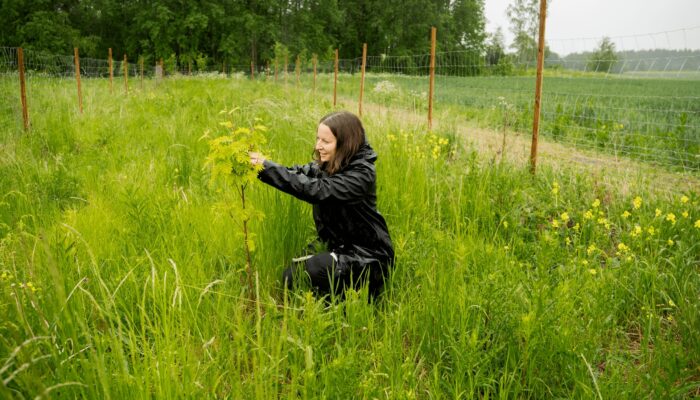
During the follow-up in June 2025, it was observed that birch, rowan, and goat willow had become established on parts of the site in Tanum. In Bålsta, several oaks and rowans had taken root, while some goat willows had not survived; supplementary planting was therefore planned. In Bålsta, butterflies, bees, and bumblebees were also observed near the wildflower meadow, along with several insect nests in the sand beds. Grey partridges were heard in the area.
Follow-up 2026 (August)
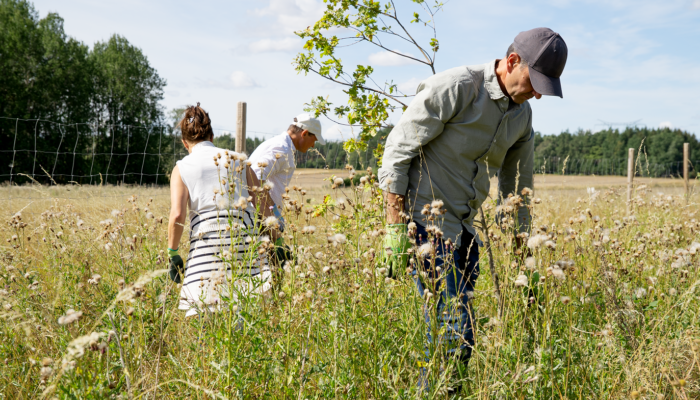
We are now in the third year of the “Forest and Pollinators” project, and in August, we returned to the project site in Bålsta to monitor progress.
The summer had been dry, which was evident during this year’s visit. The oaks, rowans, and goat willows needed some extra water, and we cleared weeds from around the trees. Since last year’s visit, the trees have grown taller, and many are now a meter or more in height. A few trees did not survive and will be replaced with new ones in the autumn.
We saw butterflies, bees, and bumblebees around the pollinator-friendly seed mix in the wildflower meadow. Several insect nests were visible in the sand beds, and the straw bales had begun to decompose and break down. On the hay meadow, we mowed the grass to reduce soil nutrient levels, thereby creating better growing conditions for the native flora.
Part of our comprehensive sustainability efforts
Sustainability work is complex. In the Forest and Pollinators project, we address the issues from multiple perspectives and engage practically in both climate and environmental matters. Partner in Pet Food Nordics AB is part of the global group Partner in Pet Food, which is working to reduce the company’s total emissions at the group level.
Read more about PPF’s sustainability work hereWould you like to contribute?
At Partner in Pet Food Nordics AB, we have invested in concrete nature conservation projects in selected locations in Sweden. We encourage other companies to explore similar opportunities to support local nature conservation initiatives. By working together, more organisations can contribute to creating better conditions for biodiversity and climate-related nature projects over time.
Do you work as a sustainability manager or corporate leader?
Contact Lisa Müller, our marketing manager and project coordinator at Partner in Pet Food Nordics AB, so that we can tell you more about what we have done and how you can follow our example.
Contact Lisa
Quick project summary
Partner in Pet Food Nordics AB is carrying out a project together with the Swedish company Initiativ 1415, focusing on carbon sequestration and biodiversity in selected project areas in Sweden. The project includes both forest-related measures and actions intended to create better conditions for wild pollinators.
The project results apply to the specific project sites and should not be interpreted as a claim about the environmental impact of the company’s products or Partner in Pet Food Nordics AB’s overall operations.

About Initiativ 1415
Initiativ 1415 is a Swedish company that helps companies finance local nature and forest projects in Sweden. These projects may include forest carbon sequestration and measures intended to support biodiversity.
Financing is partly provided through carbon sequestration certificates linked to projects where new forest is established and existing forest is conserved or managed. Estimated carbon sequestration depends on factors such as tree species, growth, soil conditions, management and time period. The certificates are therefore linked to the project’s calculation basis and follow-up, not a guarantee of a specific climate outcome.
Biodiversity projects may include measures to create habitats for pollinators in agricultural landscapes. Participating companies can follow how the financing is used and, in some cases, take part at the project sites. The work is carried out in Sweden, based on relevant recommendations from the Swedish Environmental Protection Agency and the Swedish Board of Agriculture, and in dialogue with the relevant County Administrative Board.
The name Initiativ 1415 refers to UN Sustainable Development Goals 14 and 15, which focus on marine and terrestrial ecosystems.